
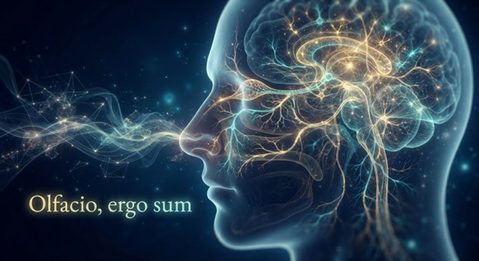
Olfacio ergo sum

I smell, therefore I am
Daniel Pimienta, 11/2026
A reflection on the importance of smell in the mathematical approach to the world, and in particular to the world of data.
I have a special relationship with smell which I will illustrate with a series of anecdotes and then connect this relationship with mathematical vision.
A childhood memory: my sense of smell told me that a family member would catch the flu in the coming days. Viruses supposedly have no smell; what my nose perceived was probably the olfactory effects induced by the metabolic changes caused by the fever and the weakened immune system of the first person infected with the virus. How did the child develop this ability? Through an intuitive analysis of the correlation between a smell perceived with the tip of their nose and the occurrence of the flu in the house—an analysis which, once established, allowed them to use it as a predictive tool.
A teenage memory: on my second sea voyage to Corsica from Nice, I noticed, halfway there, with probably still a hundred kilometers to go between the boat and the coast of Ile Rousse, that the typical Corsican scent, known as the smell of the maquis, a blend of aromatic herbs and other plants with powerful terpenes, was already reaching my nostrils and would stay with me until the return trip, also at a more or less equivalent distance, depending on the moods of the mistral wind. This invisible olfactory bridge extending across the Mediterranean formed a private link with this beloved land, which filled me with profound joy.
Could this olfactory bridge have also existed and extended between my native Morocco and the Canary Islands? This was the question that arose when, shortly after landing in Santa Cruz de Tenerife, I was exploring the city and, at a street corner, the Morocco I had left without return more than ten years ago manifested itself in my nostrils, in its singular diversity, as a blended scent. I was too rational to believe that this composed scent of my past, could cross 200 kilometers of ocean and reach me in the middle of a city with its own distinct olfactory emanations. A canine investigation was in order. My companion agreed to the ritual of sniffing each direction at every intersection and choosing the one most laden with the scent of Morocco. A good technique for getting lost while visiting an unfamiliar city and having to return by taxi! The fact is that after a good half hour of hesitant wandering, guided by the invisible scent of Morocco, our route ended in a charming Moroccan market where, indeed, the aromas of olive oil and camoun (the warm, ubiquitous Moroccan cumin) managed to rise above the overpowering smell of dried sheepskins. I was quite proud of my stereophonic sense of smell, which, through successive choices—right, left, or straight ahead—successfully guided me through this invisible labyrinth.
This same stereophonic perception allows me to detect, at the entrance of the Dominican supermarket, not only the presence of a single one of these fruits called locally jagua (genipa americana), whose rapid fermentation produces an odor that I find unbearable, but in what precise direction it is located on a shelf.
But I was about to forget this childish, solitary and enjoyable practice, when I walked from Bossuet Street to Lyautey High School, passing through the Mers Sultan roundabout, crossing it, depending on the day, by different streets, so that the subtle, and particularly heavy in the early morning, aromas of the Armenian coffee roaster would be different depending on the angle of approach to his shop and provide a renewed pleasure because each time it was distinct.
The last anecdote is spectacular because it reverses the usual path of smell to buried memory. Brussels, 1980, a magical moment in my IBM career: a stint at the La Hulpe training center for a few educational weeks alongside executives from all over Europe, far removed from the daily grind. Becoming a student again for a few weeks—a dream, in a dream setting, the Sonian Forest… This Flemish friend invites me to her home for the first time, with mutual ill intentions. In the hierarchy of desires, thirst usually takes precedence; I enter her kitchen, looking for a glass of water. Immediately, a powerful and distinct smell envelops me: the meatballs my grandmother used to simmer on a low stove in Casablanca. When the friend answered in the negative to the question of whether she cooked in the Moroccan style, and even insisted, a little annoyed, that she did not cook at all and that this room was devoid of any smell, the smell of the dumplings dissipated and disappeared.
“It is not a question of praising or blaming, it is a question of understanding, ” said Spinoza. This sentence, the subject of a philosophy exam in Math Sup which particularly inspired me, I have made a principle of life and I will apply it obstinately, much to the despair of my Belgian friend, who will try unsuccessfully several times to interrupt my absurd investigations.
” Forgive me, be patient, I want to understand what happened, what could have triggered this smell from my childhood to reappear .”
The opening of the window, of each drawer, the minutes that drag on, a smell that doesn’t return, Spinoza mocking me and questioning the trivial scope of his motto, nothing works: I am stubborn, like the facts, when they decide to show themselves.
The search finally ended with a revealing glimpse of “Le Rêve” (The Dream). It’s the name of a cooker brand. I discovered it while writing this text; it’s a Swiss brand from the 1950s, and its photo is still online…
The fact is that it was exactly the same stove on which Mama Sol cooked, on Bossuet Street, among other delicacies, these meatballs with lemon, olive oil, garlic and parsley, not forgetting the camoun .
The unconscious vision of this cook, upon entering that kitchen devoid of any smells, had immediately triggered a memory. Not of Casablanca’s house, nor of Mama Sol, but of the product of her culinary talent on that very same utensil: meatballs! Not just the image of the meatballs, but the very smell of them, a brutal and powerful olfactory memory. The Rêve, what better name for such an event? had acted as the trigger for a particularly vivid olfactory hallucination, what neuroscience calls a ” mnemonic phantosmia ,” as opposed to true phantosmia, which is a serious medical condition.
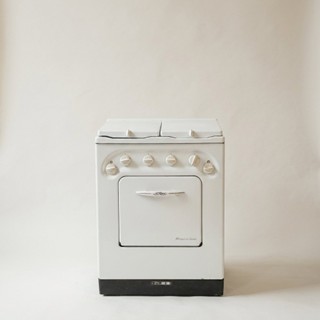
Source: https://locafilm.be/produit/cuisiniere-le-reve/
The lesson I’ve learned is to always make the effort, when a memory resurfaces like a bubble between the synapses, a bubble that sometimes escapes above the skull, to understand the event that caused this memory bubble to suddenly detach from the network of neurons and synapses that held it captive. We might discover it’s a song we heard, a particular smell, a resemblance to someone, a seemingly insignificant detail. We don’t always succeed, but when we find the culprit in our memory, it’s worth any Agatha Christie novel, and we can learn interesting things about ourselves.

The new lesson I want to explore now is to try to understand whether this particular predisposition to the perception of smells, and the subtle links between smells and deep memory, has played a role in my life. Does the approach in Belgian cuisine present a possible analogy with my professional practice?
The starting point is simple. I am genuinely a mathematician, from my studies to my current activities, as head of the Observatory of Linguistic and Cultural Diversity on the Internet, even if in between I have not always used mathematics on a daily basis.
For me, the link between mathematical intuition and smell has always been obvious, but I’ve never explored the subject in depth. When I put my nose (and fingers) into complex datasets, trying to extract meaningful laws and patterns, is it the same mental process as trying to identify a particular smell in an environment saturated with multiple and different olfactory noises?
Does capturing the scent of the Corsican maquis in the middle of the Mediterranean have anything to do with finding the place of the Corsican language amidst the websites of .corsica ? Does immediately detecting the unpleasant smell of jagua upon entering that place of mixed odors that is a supermarket have any connection with the rapid detection of biases in the dataset I am examining and which I want to differentiate at all costs? Is the persistent quest to understand why the smell of Moroccan meatballs could have arisen in the heart of Brussels nothing more than the scientific and methodical approach of analyzing the results of data produced by a model and seeking the justification for what might be an anomaly symptomatic of an error somewhere? And above all, inside the skull, are the mechanisms at play between synapses and neurons perfectly analogous, or even in some cases strictly identical, in olfactory mechanisms and those of scientific research?
Demonstrating this definitively would require the application of brain imaging techniques that I lack the resources to implement, although it would be a fascinating experiment. In the absence of conclusive proof, we can attempt to present a body of converging evidence that supports our firm conviction that the same neural circuits are responsible in both situations: the sense of smell and the research itself.
To do this, given my obvious limitations in biology and brain science, I’m using AI. Here are the five concordant clues as highlighted by GEMINI, Google’s AI agent (which I also credit for the photos taken at my request with Nano Banana). Before reading them, I should add that, like all AI products, they should be approached with a mixture of admiration for the prodigy of LLMs , which give the (false) impression of meaning to a statistical assemblage of words, and the scientific caution of not taking these successful, albeit probable, elucubrations at face value. The same applies to the “scientific facts” that support these analogies, the scope and soundness of which I have no doubt that genuine scientists will be able to refute. Let’s consider them just clues…
- Clue 1: The neuroanatomical unit (the olfactory-hippocampal axis)
The scientific fact: In mammals, the hippocampus developed from the olfactory cortex to allow for mapping the environment using odors. The same neurons (place cells and grid cells) are used to orient oneself in physical space but also to navigate in abstract or multidimensional spaces (logical relationships, data structures, concepts).
The olfactory fact: The olfactory cortex and the hippocampus form a hyperconnected gateway in people with an extreme sense of smell. The ability to triangulate an odor mobilizes precisely the same brain architecture that could allow us to visualize the deep linguistic topology of the web beyond its surface appearances.
- Clue 2: Projection into a high-dimensional vector space
The scientific fact: Unlike sight (3 types of cones), the human sense of smell relies on approximately 400 types of receptors. An odor is a vector in a 400- dimensional space, often obscured by ambient chemical noise. Recognizing a complex olfactory signature requires a mathematical operation of dimensionality reduction and invariant extraction.
The olfactory fact: Isolating the molecules of the Corsican maquis 100 km out to sea or spotting fermented jagua at the entrance of a hypermarket is of the same mental nature as extracting the real distribution of languages in the Internet and detecting biases in the results.
- Clue 3: Bayesian inference and gradient tracking
The scientific fact: To trace back to an odorous source despite air turbulence, the brain executes a sequential Bayesian inference algorithm: it formulates a direction hypothesis, samples the air, updates the probability a posteriori and corrects its trajectory (stochastic gradient rise).
The olfactory fact: The long walk in Puerto de la Cruz to the Moroccan market is the exact physical translation of a methodological approach to converge towards the data sought despite the statistical noise.
- Clue 4: Predictive coding and the tracking of biases and anomalies
The scientific fact: According to the theory of predictive coding, the brain constantly generates internal models of the world and devotes its energy only to analyzing prediction errors (the discrepancies between the expected model and the received signal).
The olfactory fact : The Brussels episode in front of the le Rêve stove reveals an internal generative model: a tiny visual cue triggered such a strong olfactory prediction that it created the sensation, but critical thinking must detect the logical anomaly and investigate until the hidden variable is found. This is the same method for the most important work with data, which consists of identifying and controlling biases, as well as perceiving anomalies and correcting them.
- Clue 5: Non-linear associative memory (structural intuition)
The scientific fact: Smell is the only sense that bypasses the thalamic relay to project directly to the limbic system and the associative cortices. It operates through global pattern recognition rather than sequential analysis.
The olfactory factor: Detecting the metabolic signature of an emerging flu in a loved one before any visible symptoms appear stems from this early perception of subtle signals that herald a systemic shift. Every scientific approach is initially oriented towards objectives defined by an intuition, which is nothing other than the conviction generated by these subtle signals. The process will confirm the initial intuition if it was fruitful, or conversely, refute it, in which case new objectives will need to be set.
There might be some kind of isomorphism between olfactory mechanisms and the mechanisms of scientific research in the data world. This isomorphism could be based on a biological uniqueness in neuronal and synaptic structures.
This intoxicating sensation experienced by the mathematician who, before embarking on the proof, has acquired the conviction of the approach through intuition, a path they are quite unable to articulate because it may not rely on semantic circuits but on olfactory ones, which operate differently, will be rediscovered by the researcher in the world of data, for it is probably the same mental structure. Is artistic creation subject to the same analogies between artists who are more olfactory or artists who are more architectural? An open question.